-(1).png)

The science behind deep cleaning: Beyond sweeping and vacuuming
The invisible world beneath your feet. Every time Maria walks across her Brooklyn brownstone's original hardwood floors, she's not just moving through her living room. She's traversing a complex ecosystem—one that includes thousands of microscopic organisms, chemical residues, and particles so small they remain airborne for hours.
"I sweep every day," she told me during a consultation. "My floors look clean. But my daughter's allergies keep getting worse, and I can't figure out why."
The answer wasn't in what Maria could see. It was in what she couldn't.
Regular cleaning—the sweeping, the quick vacuum, the surface wipe—addresses maybe 30% of what actually needs removing from our homes. The other 70%? That's where the science of deep cleaning comes in. And understanding that science doesn't just make you a more informed homeowner. It transforms how you think about the space where you eat, sleep, breathe, and raise your family. Let's pull back the curtain on what professional deep cleaners know—and why it matters for your health, your home's longevity, and yes, even that mysterious allergy that won't quit.
What "clean" actually means: The microbiology of your home
Here's something that might surprise you: your home has a microbiome, just like your gut. According to research published in Proceedings of the Royal Society B, the average home contains between 40,000 and 80,000 different bacterial species. Before you panic, remember that most are harmless or even beneficial. But the balance matters—and so does the location.
The bacterial geography of your house
Not all rooms are created equal, microbiologically speaking. A fascinating 2022 study from Cell Reports mapped bacterial distribution across homes and found distinct "signatures" for different spaces:
-0221100004.png)
What this means for cleaning: Surface disinfection in kitchens and bathrooms targets high-risk pathogens, while bedroom deep cleaning focuses on allergen removal rather than sterilization. One approach doesn't fit all.
The dust you can't see
That visible dust bunny in the corner? It's the tip of the iceberg. Household dust is a complex mixture containing:
- Dead human skin cells (up to 70% of dust by weight, according to the American Chemical Society).
- Pollen and outdoor pollutants tracked in on shoes and air currents.
- Pet dander and insect debris (including dust mite feces—a major allergen).
- Microplastics and synthetic fibers from clothing, carpets, and upholstery.
- Heavy metals like lead and arsenic, particularly in older urban homes.
The Environmental Science & Technology journal found that the average home accumulates approximately 40 pounds of dust annually. Regular cleaning removes the top layer. Deep cleaning removes the embedded reservoir that continues releasing particles into your air.
-
The chemistry of clean: Why products work (or don't)
Walk down any cleaning aisle and you'll face a wall of promises: "kills 99.9% of germs," "deep clean action," "professional strength." But what's actually happening at the molecular level?
Surfactants: The unsung heroes
At the heart of every effective cleaner is a surfactant—short for "surface active agent." These molecules have a split personality:
- Hydrophilic head (loves water).
- Hydrophobic tail (loves oil and grease).
When you apply a surfactant solution to a dirty surface, the tails embed themselves in oily grime while the heads remain in the water. Agitation (scrubbing) lifts the dirt, and rinsing carries it away. Without surfactants, you're just moving dirt around.
The professional difference: Deep cleaning uses surfactants matched to specific soil types. Alkaline cleaners (pH 9-14) break down organic matter like grease and proteins. Acidic cleaners (pH 0-6) dissolve mineral deposits and rust. Neutral cleaners (pH 6-8) handle daily maintenance without damaging surfaces.
-0221101010.png)
The dwell time factor
Here's where most DIY cleaning goes wrong: contact time. The Centers for Disease Control and Prevention (CDC) emphasizes that disinfectants require specific dwell times—usually 5-10 minutes—to effectively kill pathogens. Spray-and-wipe immediately? You've just relocated bacteria, not eliminated them.
Professional deep cleaning builds dwell time into the process. We apply solutions, allow them to work, then remove them completely. It's slower. It's more effective. And it's why your kitchen doesn't smell like a chemical factory afterward—we're not using more product; we're using it correctly.
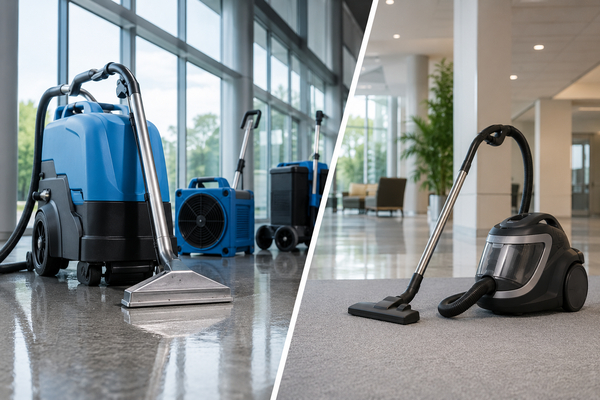
The physics of particle removal: Why your vacuum lies to you. That satisfying line of carpet fluff your vacuum leaves behind? It's mostly cosmetic. Understanding particle physics explains why.
-0221095123.png)
The Environmental Protection Agency (EPA) identifies PM2.5 as particularly dangerous because these particles bypass natural respiratory defenses and enter the bloodstream, contributing to cardiovascular disease, lung cancer, and premature death.
Your standard vacuum: Captures particles down to about 50 microns if you're lucky, and that's assuming the filter isn't clogged. Many recirculate smaller particles back into your air.
Professional deep cleaning equipment: Uses sealed HEPA filtration (99.97% efficiency at 0.3 microns) and often includes HEPA-filtered air scrubbers that actively clean the air while surfaces are being treated.
The ionization secret
Ever wonder why dust seems to reappear immediately after cleaning? Static electricity. Friction—walking on carpet, sitting on upholstery, even air moving across surfaces—creates static charges that attract particles like a magnet.
Professional deep cleaning often employs anti-static treatments or uses equipment with ionization technology that neutralizes charges, preventing immediate re-deposition. It's not magic; it's physics.
The biology of allergens: Why deep cleaning matters for health
For the 50 million Americans with allergies (that's 1 in 5, according to the Asthma and Allergy Foundation of America), deep cleaning isn't aesthetic—it's medical.
Dust mites: The invisible enemy
These microscopic arachnids (yes, they're related to spiders) don't bite or sting. They don't transmit disease. But their fecal pellets contain proteins that trigger allergic reactions in 20 million Americans.
The biology:
- Dust mites thrive in humidity above 50%.
- They feed on human skin cells (remember that 70% of dust?).
- One mattress can harbor 100,000 to 10 million mites.
- Each mite produces approximately 20 fecal pellets daily.
- These pellets are 10-40 microns—perfectly sized to become airborne and inhaled.
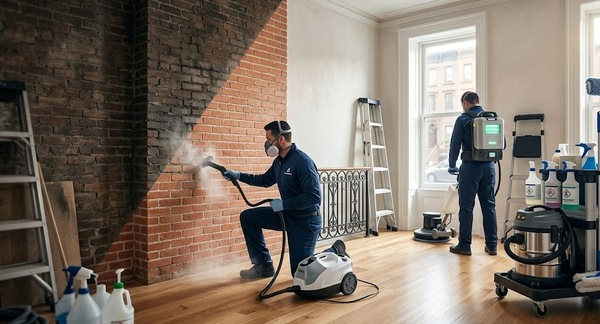
Deep cleaning intervention: Steam cleaning at temperatures above 130°F (54°C) kills dust mites instantly. HEPA vacuuming removes dead mites and fecal matter. Encasements prevent re-infestation. Regular surface cleaning? It barely makes a dent.
Mold: More than a smell
That musty odor in your bathroom or basement signals active mold growth—and potentially mycotoxin production. The World Health Organization estimates that 10-50% of indoor environments in North America have moisture problems sufficient to support mold growth.
Mold reproduces via spores (2-100 microns) that remain viable for years. When humidity rises above 60%, they germinate. Deep cleaning addresses not just visible mold but the hyphae (root structures) that penetrate porous materials and the spore reservoir that ensures rapid return if not removed.
-0221094529.png)
The pH damage you can't see
That "multi-surface cleaner" under your sink? Probably pH 10-11 (alkaline). Safe for ceramic tile. Disastrous for marble (calcium carbonate, which dissolves in acid but etches in alkaline solutions). For hardwood finishes (typically polyurethane, sensitive to high pH). For wool carpets (protein fibers that degrade in high pH).
Professional deep cleaning matches chemistry to material. It's why we carry 8-12 different cleaning agents rather than one "all-purpose" solution.
-
The psychology of clean: Why deep cleaning feels different
There's a reason walking into a professionally cleaned space feels different. It's not just visual; it's psychological and physiological.
- Olfactory science: Your sense of smell connects directly to the limbic system—brain structures governing emotion and memory. "Clean" smells (citrus, pine, "fresh air") trigger positive associations. But here's the trick: true cleanliness has minimal odor.
- That heavy "clean" fragrance many products leave? It's masking agents, not cleanliness. Volatile organic compounds (VOCs) in fragrances can trigger headaches, respiratory irritation, and in sensitive individuals, asthma attacks.
- Professional deep cleaning aims for olfactory neutrality—the absence of odor indicating the absence of odor-causing substances. When we do use scents, they're botanical, low-VOC, and subtle.
- Visual perception: Research from Psychological Science shows that visual clutter elevates cortisol (stress hormone) levels. But it's not just tidiness—it's completeness. A surface that's been wiped but still shows streaks or residue triggers subtle cognitive dissonance. Deep cleaning's thoroughness satisfies this psychological need for completion.
-0221093956.png)
The equipment investment for professional-grade deep cleaning runs $15,000-$50,000. The training to use it effectively takes months. For most homeowners, professional service isn't a luxury—it's practical economics.
-0221093459.png)
Clean as a system, not a task
The science of deep cleaning reveals something profound: cleaning isn't a series of tasks but an integrated system. Chemistry, physics, biology, and material science all intersect in your living room.
When you understand this—when you move beyond "sweep and wipe" to "identify, target, and remove"—you're not just maintaining your home. You're optimizing the environment where your family lives, breathes, and grows.
That allergy Maria couldn't solve? After a professional deep cleaning targeting dust mite reservoirs, HEPA filtration of airborne particles, and humidity control to prevent recurrence, her daughter's symptoms reduced by 70% within three weeks. The science worked. Your home deserves more than surface attention. It deserves the thoroughness that only understanding—and applying—the science of clean can provide.
Ready to experience the science of clean in your home?
At Brooklyn Community Cleaners, we offer more than just a surface clean. We provide the perfect solution to enjoy impeccable spaces without worries, allowing you to focus on growing your business while we handle the precision. Book your professional cleaning service today and enjoy a clean, fresh, and healthy environment! Contact us today for a free quote and discover how BKCC can help you create a healthier and more pleasant workplace.
Schedule your free in-home health assessment today ? Contact us today for a free quote!
Brooklyn Community Cleaners applies evidence-based protocols to every service. Because your family deserves cleaning that works as smart as it looks.
----
Sources
: Dunn, R. R., et al. (2013). "Home life: factors structuring the bacterial diversity found within and between homes." *PLoS ONE*, 8(5), e64133.
: Hartmann, E. M., et al. (2022). "Microbiota of the indoor environment: a meta-analysis." *Cell Reports*, 38(12), 110543.
: *American Chemical Society*. (2009). "What's in household dust?"
: Deville, P., et al. (2015). "Dynamic population mapping using mobile phone data." *Proceedings of the National Academy of Sciences*, 112(45), 13963-13968.
: *Centers for Disease Control and Prevention*. (2020). "Guidelines for Environmental Infection Control in Health-Care Facilities."
: *U.S. Environmental Protection Agency*. (2023). "Particulate Matter (PM) Pollution."
: *Asthma and Allergy Foundation of America*. (2023). "Allergy Facts and Figures."
: Arlian, L. G., & Platts-Mills, T. A. (2001). "The biology of dust mites and the remediation of mite allergens in allergic disease." *Journal of Allergy and Clinical Immunology*, 107(3), S406-S413.
: *World Health Organization*. (2009). "WHO Guidelines for Indoor Air Quality: Dampness and Mould."
: Steinemann, A. (2017). "Ten questions concerning air fresheners and indoor built environments." *Building and Environment*, 111, 279-284.
: Saxbe, D. E., & Repetti, R. (2010). "No place like home: home tours correlate with daily patterns of mood and cortisol." *Personality and Social Psychology Bulletin*, 36(1), 71-81.
Comment